Wednesday, October 31, 2007
Thursday, July 19, 2007
How To Watch Satellite & Cable TV On Your PC FREE - Tips
Today you can get instant access to watching satellite TV on your PC but is it all as good as they say. These are how to watch satellite & cable TV on your PC FREE - Tips
NEGATIVES:
For some shows I watch such as my favourite live sport show you have to get it set up 10- 15 minutes beforehand otherwise you not going to get as good of a feed.
As this is not a paid TV cable or satellite service there is buffering involved which means you might have to wait under a minute or two before you can watch a particular program.
Depending on the speed of your computer, if it is a dial up I probably wouldn’t advise you to consider this.
POSITIVES:
Over 3000 STATIONS on your PC or Laptop for a one time low fee. That means you can stop paying for high-priced cable or satellite services! Watch LIVE Games (even the games that are not shown elsewhere) - With this software!
There are no subscriptions needed and no recurring charges and the picture is DVD quality.
The choices you get are sports such as ESPN, news, movies, music, weather, kids channels, educational, shopping, clips plus radio stations and much, much more. It works anywhere in the world with no need to buy extra hardware equipment or a PC TV card because the TV channels are streamed through your internet connection. You just need an Internet connection.
Watch TV in English, Spanish, German, Arabic, French, Italian, Russian, Dutch and more. You may also browse world TV by regions or by country name you do this by choosing a country and watch there TV programs from that country so many to choose from.
They will be adding many more quality stations in the near future such as ESPN 2, MTV USA, HBO, Playboy TV, Pay Per View, + many more.
There is a forum, which helps you out if you have any questions.
MY CONCLUSION: Satellite TV for your PC is solely I believe up to your computer if you have dial up I wouldn’t recommend it. Otherwise if you don’t mine waiting for the buffering to watch your program and also a one time low fee to watch satellite TV on your PC then its forever free instead of paying recurring charges to watch on your TV this is the way to go. How To Watch Satellite & Cable TV On Your PC FREE - Tips
About The Author
Tony Pescatore finds and writes helpful information on topics he believes in.
You get a quick review or buyers on some of best software available online today.
Check Out TV Over Internet Blog

Wednesday, July 18, 2007
Create Your Own Digital Library
The moment you got your first digital camera, your view of the world has totally changed. You always seem to see something beautiful or artistic in your surroundings, worthy of being captured in pixels. You experiment quite a lot and keep on loading your pictures in your computer. Until one day, you thought of working on a project. You’re sure you have the kind of picture you need – you knew you have it somewhere in your hard disk… in one of those folders… You can’t run a search for it though because you pretty much use generic filenames like Flower1, Flower2, Flower 3 and so on. Uh-oh! Looks like it’s high time for you to organize your digital photos!
Microsoft has something that can help you do that. It’s called the Microsoft Digital Image Suite 9, which actually consists of two imaging applications – MS Digital Image Library 9, which serves as your database of digital images and MS Digital Image Pro 9, which is a photo manipulation program.
A lot of people may like it’s familiar Explorer-like interface – the left pane being the folder pane, while the right side of the window is the image browser, showing thumbnails of your images.
The good thing about Digital Image Library 9 is that you wouldn’t have to transfer your photos from their current location. Instead, it scans your hard disk and locates folders it considers photo folders, afterwhich you may deselect folders that are not appropriate. The images may then be sorted according to date or keywords. From here, you may double-click on a photo to bring it up in a full-screen view and use the basic controls for zoom, fit to screen, rotate and print. You may also select multiple photos for slideshow, the speed of which range from 1 second to 1 minute.
Oftentimes, pictures taken with a digital camera contains metadata. These are information about the photo, such as shutter speed and the date and time the photo was taken. Digital Image Library 9 allows you to add these metadata with captions and keywords to easily categorize and later on identify images. Another nifty feature of this application is that it even allows you to rate your photos! From the preview pane, simply click on how many stars, the highest being five, you wish to assign each photo.
If you wish to do some retouches on an image, simply click the edit button and Digital Image Pro 9 launches and opens the selected image. This application has a lot of quick-fix features such as the Red Eye tool and the Smart Erase, which caters to novice retouchers and home users who don’t want anything complicated.
Being the all-in-one application that it is, Microsoft Digital Image Suite 9 comes with tons of mats, frames and templates for creating professional photo projects such as scrapbooks, photo albums, calendars and postcards. You may also get Microsoft Photo Story, an add-on to the suite that lets you turn your photos into video. Simply choose which photos to include then add some narration if you have a microphone and add music and zooming effects.
About the author:I like to read anything that contains words in the old English form, though I can’t understand it. You know, the King James Version of the Bible with words like thou, thy, thine, wilst, etc. The words used are different. The construction of the sentence is different, too, which makes sentences sound artistic. I also like gothic metal, a music genre, because most of the lyrics contain such words. It is not only the words that fascinate me; it’s the hidden meaning it contains. It’s like an abstract painting; you don’t get the real picture until you see through it.
For comments and inquiries about the article visit http://www.ucreative.com
Get the latest on Streaming Internet TV at my TV over Internet Blog
Monday, July 16, 2007
Internet TV Software
Lately I have been looking at some applications that would utilize wireless broadband service especially 4G category.
The application to mention here is Internet TV. These are basically applications that act as a guide to Internet broadcast from the various Television providers. The advantage with these are that you can find stations from all continents which is not likely with Cable TV.
The general search term I have seen for these are Satellite TV on PC or similar phrases.
You can find more information on these applications on my tv over internet blog.
Imagine having this capability on your Iphone device with WiMAX or LTE technology.
Monday, April 16, 2007
Internet Type Tablet
http://www.irextechnologies.com/
Still a little pricey for where I would like it to be, but a good start.
Saturday, April 14, 2007
Mobile Video update
http://www.youtube.com/mobile
This allows live posting of video on the go. See a Demo here
Thursday, February 08, 2007
WiMAX - The 4G beach head
The other side to look at, is the option for always connected. There is definitely a need for a unified connectivity solution.
To address all of that several technology solutions are been pursued. A few are WiMAX, EVDO Rev C and LTE.
Of all those WiMAX will be the first one out the door with full support for OFDM and MIMO. Most believe that eventually LTE will make it out and dominate the 4G especially since spectrum migration could much simpler than WiMAX.
In any case with carriers such as Sprint pursuing WiMAX, its fair to say this will be the first wave of 4G. It will help to mold the applications and innovators find ways to utilize bandwidth on the go.
Stay tuned for more
Tuesday, July 04, 2006
Free online courses
Here is a link to some free MBA type courses.
http://business-technology.us/news.html
They have some good practical stuff as well.
Also check out open courseware links
http://iberry.widged.com/html/ocd.htm
Monday, May 08, 2006
Video on the go
The sling box
http://www.slingmedia.com/
Then the pocketdish
http://www.pocketdish.com/
More to come soon
Tuesday, March 28, 2006
Neuro Interactions
www.cyberkineticsinc.com
Enjoy
Friday, February 24, 2006
Wifi VOIP Phones
Friday, January 27, 2006
Some news
This is an article I just ran into http://www.forbes.com/2006/01/24/tello-wireless-software-cz_qh_1024tello.html?partner=msn
Thursday, January 26, 2006
Network Services
Currently Cellphones and Landlines work just fine, but then VOIP is still very hot as a way to make calls. The same thing applies to TV and video.
What is apparent is that the increase use of the Internet has attracted the need to provide services in different ways. For example nowadays, you can download a PC TV client and there you have full access to many TV stations (example http://beelinetv.com/). This actually is more than getting TV in another way, it actually allows you see TV from just about anywhere, which could be expensive with satellite and totally not possible with Cable at low cost.
In the case of VOIP, it would seem that this is driven by cost but then in some practical ways it solves some current problems such as proper cellphone coverage in buildings. WIFI/GSM/CDMA hybrid phones will solve this issue over time as well. On company is taking a different approach by allowing better indoor Cell coverage (www.spotwave.com).
This brings me back to the need for good broadband wireless. Obviusly the sophisticated user may want everything available but I would think more of the user with limited access to wired networks for both cable and Internet access. The presence of the Wireless connection would allow the user to access regular data services, like finding the best deal anywhere in the world, services such as TV since may not want to buy expensive satellite and maintain. The additional premium is VOIP in your house. Companies such as www.vonage.com already have the soltuion once you have a connection.
In summary it seems connectivity will provide better services and eventually change the way you do things.
Monday, January 16, 2006
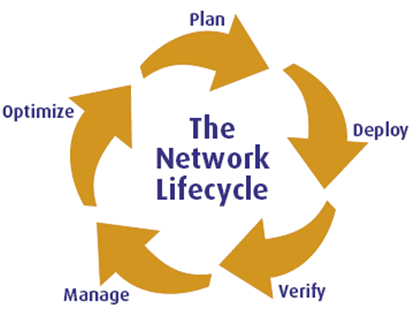
Planning and Building a network
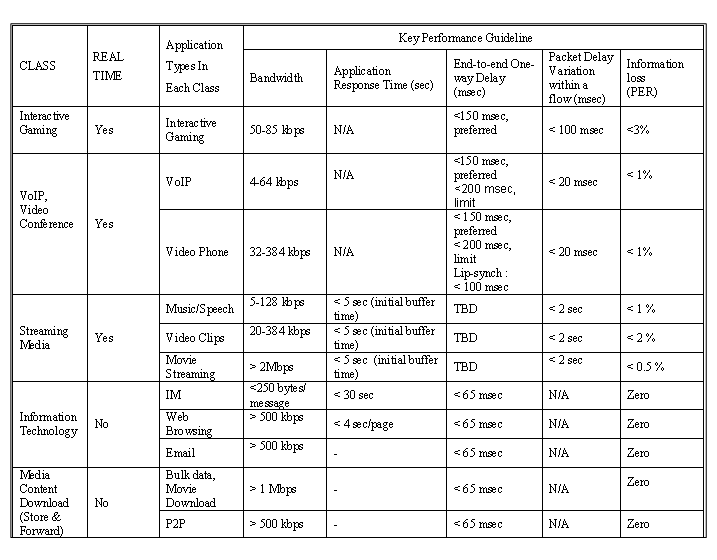
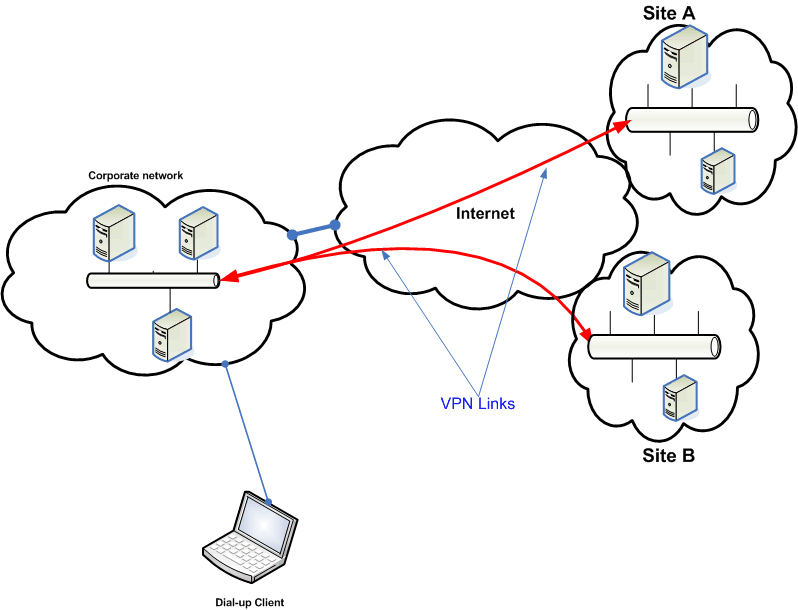
Connectivity, affects how users are connected to the network or how a site is connected to other sites. This could be driven by application requirements or availability options as in the case with Workers Bank. Wireless maybe used in a campus environment while a WAN would have ADSL, T1, DS3 or in some cases Metro Ethernet. Security would come in different levels including physically securing network equipment, limit access to the network and protecting actual network data with encryption for example. The following is an example of connectivity using Virtual Private Network (VPN) protocol such as Internet Protocol Security (IPSEC – RFC2401).
Reliability covers many aspects from physical provisioning such as battery backups to protocols used in link failures. Protocols used at MAC layer are 802.1d (STP), LAG, and MLPPP. Network layer could use dynamic routing, VRRP and Server load balancing implementation.
Documenting the design with all the above factors could mean using simulation models to fine the design then move to implementation.
Deployment or implementation means planning and ensuring the environment is ready, pre-stage and test equipment to ensure things will go smoothly. You then need to verify the installation using the many management tools available which can also be used for long term management.
Management means to ensure the network is available and look at parameters that may require optimization or generate a new network project for example with addition of more users or more demanding applications.
Broadband Pointers
http://www.bbwexchange.com/howto/
Will add some notes soon on how to design a network, both Enterprise and ISP base
Wednesday, December 07, 2005
Free Teleconferencing
I was looking for a low cost conferencing service to discuss some business ideas.. I ran into this one that is free for up 50 persons at a time.. thats good enough for me...
Here is the site
http://www.freeconferenceservice.com/index.htm
Happy conferencing
Saturday, November 26, 2005
Challenges of Internet Computing
In the enterprise, computing is seen as the engine for the basic day to day management of services and production. It also becomes a major vehicle for communication within and without the enterprise. Part of this communication covers areas such as provide information on services and products, selling the products and interacting with suppliers and purchasers of those products. With all this information in a growing database, management can extract and model data to make decisions such as best areas to focus, areas to invest and also those that should be discontinued.
As we look at the applications within the enterprise, we see an extension of this for the consumer. Using the example of the landline phone, we see that it became a standard part of communication and thus the eventual success of cell phones that represent the concept of been always connected.
Well, it would seem that voice communication by itself would be always be enough to stay in touch but with the availability of data using communication, this piece is becoming more important increasingly. There are currently several ways to stay connected in the data world but there is still lack of full integration in all areas. For example, the consumer wants to see whats happening around locally and international, make direct decisions for example on a stock trade or purchase anything. The other pleasant side is someone on vacation may want to show someone live a monument or event that is once in a lifetime.
The main enablers to achieve this level of integration are adequate and portable computing power plus appropriate and cheap bandwidth for sustained communications. To connect this together, there is also need for versatile applications. Some of these are VOIP, voice recognition and data mining technology.
While we can talk of these possibilities in the developed world and most urban centers, there is still a gap for information infrastructute in rural and underdeveloped countries. This is very much the case even in developed countries as well. The question that lingers is, how to make the leap for these areas and what would be appropriate to these cultures? It may be wrong to assume that just providing a computer and communication would simply bring these persons into the fold. It may be relevant to understand how these people value this need and how would they interact with such system. This comes to the issue of literacy; are they literate in the standard languages that is been used for mainstream communications?
Looking at the success of cell phones in developing countries, it seem that there exist some need to be connected and the beauty of the cell phone is that people can communicate in whatever language that they wish to communicate. On the other hand, the internet pages or services may not exist in many native and undocumented languages. This means that translation in some form would be helpful to reach these populations. This could solve by either educational means or develop technology to accomplish the same results.
Many times, the view is always that uneducated persons does not represent much of economic impact, thus the motication for investment is nulified. This may not be an accurate assessment since from simple observation we can see that a vast majority of the worlds population leaves in poorer countries or poor conditions. This means there is an oppurtunity to brings these people into the economic mainstream and create even larger economic impact.
To solve these intricate problems need further analysis and research, the dicussion will definitely continue on this.
Here is a link to review in the meantime - http://www.isoc.org/oti/articles/1196/sadowsky.html
Another good one - http://cse.stanford.edu/class/cs201/projects-00-01/third-world/
Tuesday, November 08, 2005
Innovative portable Computer
http://domino.research.ibm.com/comm/pr.nsf/pages/news.20020206_metapad.html
This fit into model of new ways of man machine interaction
Monday, October 31, 2005
Wearable Computers
Here is the link. Will have more comments later
http://www.media.mit.edu/wearables/
