Friday, February 24, 2006
Wifi VOIP Phones
Today you can find phones that work well for 802.11 networks especially for an Enterprise or campus type scenario. An example is here http://www.zyxel.com/product/P2000W.phpWhile that solution can help very much, the best deal would be to marry 802.11 capability with existing GSM or CDMA phones. This approach is slowly picking up traction especially with respect to costing requirements.The capability will have reachability, since sometimes cell phones will not work in some areas of the office. On the other hand, it could be separate numbers, with the 802.11 portion been tied to your regular extension.Here is an article on these phones..

Friday, January 27, 2006
Some news
Just a quick one.
This is an article I just ran into http://www.forbes.com/2006/01/24/tello-wireless-software-cz_qh_1024tello.html?partner=msn
This is an article I just ran into http://www.forbes.com/2006/01/24/tello-wireless-software-cz_qh_1024tello.html?partner=msn
Thursday, January 26, 2006
Network Services
It always seem that from time to time, you end up saying the same thing in a different way. This comes to mind when we look at the issue of convergence.
Currently Cellphones and Landlines work just fine, but then VOIP is still very hot as a way to make calls. The same thing applies to TV and video.
What is apparent is that the increase use of the Internet has attracted the need to provide services in different ways. For example nowadays, you can download a PC TV client and there you have full access to many TV stations (example http://beelinetv.com/). This actually is more than getting TV in another way, it actually allows you see TV from just about anywhere, which could be expensive with satellite and totally not possible with Cable at low cost.
In the case of VOIP, it would seem that this is driven by cost but then in some practical ways it solves some current problems such as proper cellphone coverage in buildings. WIFI/GSM/CDMA hybrid phones will solve this issue over time as well. On company is taking a different approach by allowing better indoor Cell coverage (www.spotwave.com).
This brings me back to the need for good broadband wireless. Obviusly the sophisticated user may want everything available but I would think more of the user with limited access to wired networks for both cable and Internet access. The presence of the Wireless connection would allow the user to access regular data services, like finding the best deal anywhere in the world, services such as TV since may not want to buy expensive satellite and maintain. The additional premium is VOIP in your house. Companies such as www.vonage.com already have the soltuion once you have a connection.
In summary it seems connectivity will provide better services and eventually change the way you do things.
Monday, January 16, 2006
Planning and Building a network
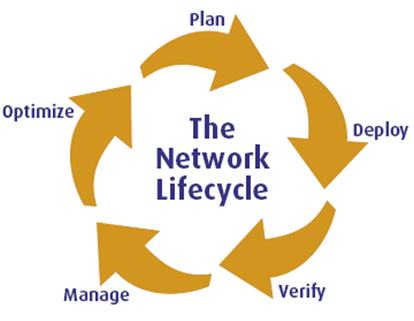
Building a network requires careful consideration of the process and parameters that will drive its success. The illustration shows the general process applied to a network
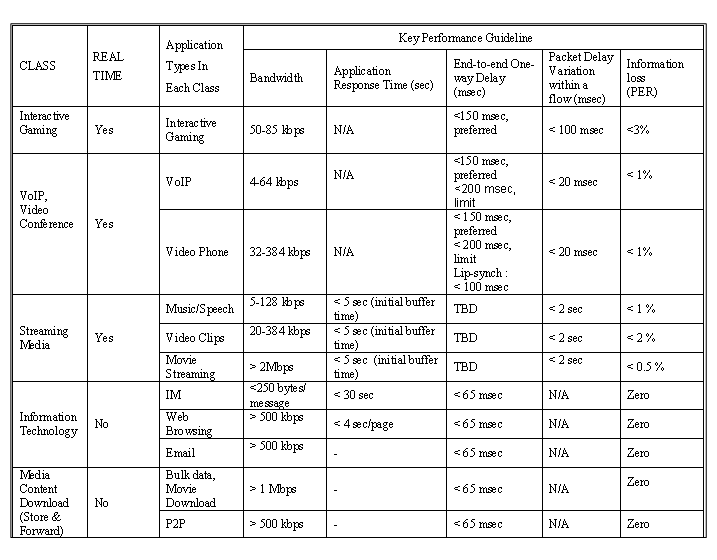
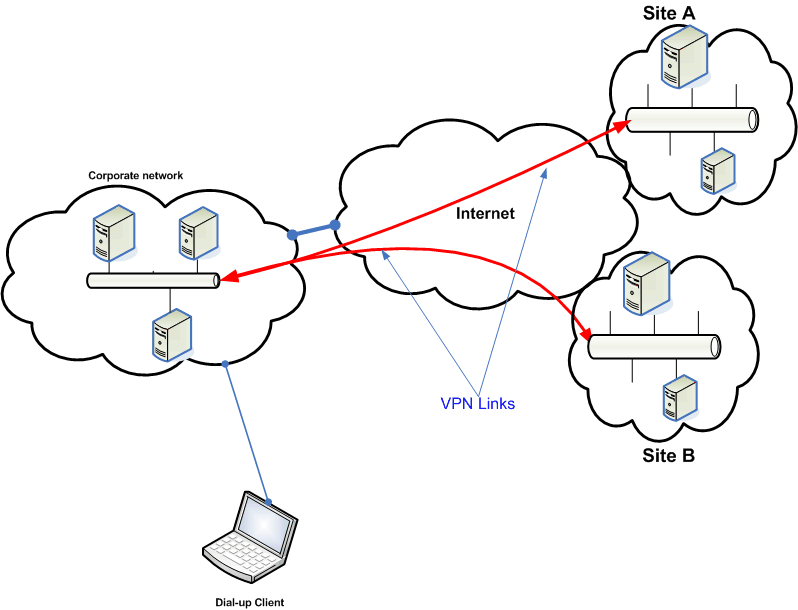
Connectivity, affects how users are connected to the network or how a site is connected to other sites. This could be driven by application requirements or availability options as in the case with Workers Bank. Wireless maybe used in a campus environment while a WAN would have ADSL, T1, DS3 or in some cases Metro Ethernet. Security would come in different levels including physically securing network equipment, limit access to the network and protecting actual network data with encryption for example. The following is an example of connectivity using Virtual Private Network (VPN) protocol such as Internet Protocol Security (IPSEC – RFC2401).
Reliability covers many aspects from physical provisioning such as battery backups to protocols used in link failures. Protocols used at MAC layer are 802.1d (STP), LAG, and MLPPP. Network layer could use dynamic routing, VRRP and Server load balancing implementation.
Documenting the design with all the above factors could mean using simulation models to fine the design then move to implementation.
Deployment or implementation means planning and ensuring the environment is ready, pre-stage and test equipment to ensure things will go smoothly. You then need to verify the installation using the many management tools available which can also be used for long term management.
Management means to ensure the network is available and look at parameters that may require optimization or generate a new network project for example with addition of more users or more demanding applications.
Broadband Pointers
Haven't been logging any activity in a while.. Here is a good link for planning Wireless Broadband in an area.
http://www.bbwexchange.com/howto/
Will add some notes soon on how to design a network, both Enterprise and ISP base
http://www.bbwexchange.com/howto/
Will add some notes soon on how to design a network, both Enterprise and ISP base
Wednesday, December 07, 2005
Free Teleconferencing
This is a quick one.
I was looking for a low cost conferencing service to discuss some business ideas.. I ran into this one that is free for up 50 persons at a time.. thats good enough for me...
Here is the site
http://www.freeconferenceservice.com/index.htm
Happy conferencing
I was looking for a low cost conferencing service to discuss some business ideas.. I ran into this one that is free for up 50 persons at a time.. thats good enough for me...
Here is the site
http://www.freeconferenceservice.com/index.htm
Happy conferencing
Saturday, November 26, 2005
Challenges of Internet Computing
Computing has changed a lot over the last many years, but it seem that we can meaure this change in the applications and value that they bring.
In the enterprise, computing is seen as the engine for the basic day to day management of services and production. It also becomes a major vehicle for communication within and without the enterprise. Part of this communication covers areas such as provide information on services and products, selling the products and interacting with suppliers and purchasers of those products. With all this information in a growing database, management can extract and model data to make decisions such as best areas to focus, areas to invest and also those that should be discontinued.
As we look at the applications within the enterprise, we see an extension of this for the consumer. Using the example of the landline phone, we see that it became a standard part of communication and thus the eventual success of cell phones that represent the concept of been always connected.
Well, it would seem that voice communication by itself would be always be enough to stay in touch but with the availability of data using communication, this piece is becoming more important increasingly. There are currently several ways to stay connected in the data world but there is still lack of full integration in all areas. For example, the consumer wants to see whats happening around locally and international, make direct decisions for example on a stock trade or purchase anything. The other pleasant side is someone on vacation may want to show someone live a monument or event that is once in a lifetime.
The main enablers to achieve this level of integration are adequate and portable computing power plus appropriate and cheap bandwidth for sustained communications. To connect this together, there is also need for versatile applications. Some of these are VOIP, voice recognition and data mining technology.
While we can talk of these possibilities in the developed world and most urban centers, there is still a gap for information infrastructute in rural and underdeveloped countries. This is very much the case even in developed countries as well. The question that lingers is, how to make the leap for these areas and what would be appropriate to these cultures? It may be wrong to assume that just providing a computer and communication would simply bring these persons into the fold. It may be relevant to understand how these people value this need and how would they interact with such system. This comes to the issue of literacy; are they literate in the standard languages that is been used for mainstream communications?
Looking at the success of cell phones in developing countries, it seem that there exist some need to be connected and the beauty of the cell phone is that people can communicate in whatever language that they wish to communicate. On the other hand, the internet pages or services may not exist in many native and undocumented languages. This means that translation in some form would be helpful to reach these populations. This could solve by either educational means or develop technology to accomplish the same results.
Many times, the view is always that uneducated persons does not represent much of economic impact, thus the motication for investment is nulified. This may not be an accurate assessment since from simple observation we can see that a vast majority of the worlds population leaves in poorer countries or poor conditions. This means there is an oppurtunity to brings these people into the economic mainstream and create even larger economic impact.
To solve these intricate problems need further analysis and research, the dicussion will definitely continue on this.
Here is a link to review in the meantime - http://www.isoc.org/oti/articles/1196/sadowsky.html
Another good one - http://cse.stanford.edu/class/cs201/projects-00-01/third-world/
Tuesday, November 08, 2005
Innovative portable Computer
Here is a link from IBM with a new portable computer that can be transformed very easily for different uses.
http://domino.research.ibm.com/comm/pr.nsf/pages/news.20020206_metapad.html
This fit into model of new ways of man machine interaction
http://domino.research.ibm.com/comm/pr.nsf/pages/news.20020206_metapad.html
This fit into model of new ways of man machine interaction
Monday, October 31, 2005
Wearable Computers
Keeping with my plans. I decided to provide a link to the MIT media lab on wearable computer research. In fact I help to setup our wireless Mesh Network at this lab. We developed the mesh along with MIT research.
Here is the link. Will have more comments later
http://www.media.mit.edu/wearables/
Here is the link. Will have more comments later
http://www.media.mit.edu/wearables/
Back on track
Well, I am back here now after a couple weeks off. Experience some of the early effects of Wilma in Jamaica with lots of rain.
My intended focus here is to research developments in the area of broadband communication and the relevant technologies in respect to man->network->man interaction.
I will do some work in the area of Man-Machine interaction in the next few weeks then come back to the wireless side of things later or when something interesting pops up.
Ran into this reggae artist out in Jamaica too, that seems very good. Name is Benjy Myaz. Website at www.benjymyaz.com. Seem to be doing some refreshing new type of reggae.
Thursday, October 13, 2005
MIT $100 Laptop initiative
This is very good development, trying to make the laptop cheap for children. This could revolutionize the whole thinking on network availability.
Honestly, if you can get a laptop for $100 here, there is no reason we could not get that commercially.
Here is the link for more details
http://laptop.media.mit.edu/
Honestly, if you can get a laptop for $100 here, there is no reason we could not get that commercially.
Here is the link for more details
http://laptop.media.mit.edu/
Tuesday, October 11, 2005
Wireless base TV
I just ran into this company that provides the service for TV over Cellphones. Now this explains why good broadband is needed.
Check out at http://www.smartvideo.com/index.html
Currently, this technology works over EVDO but with cheap WiMAX the application usage could increase significantly.
Check out at http://www.smartvideo.com/index.html
Currently, this technology works over EVDO but with cheap WiMAX the application usage could increase significantly.
Wednesday, October 05, 2005
Hypercast
Here is another useful application project. Will attend a presentation from the Professor on this later this month.
http://www.cs.virginia.edu/~mngroup/hypercast-2004/overview.html
Sounds very useful
http://www.cs.virginia.edu/~mngroup/hypercast-2004/overview.html
Sounds very useful
Wireless Mesh Technology
Just a quick one on this new link.
Wireless Mesh is the technology that basically connects Wireless Access Points into a network using a wireless backhaul in place of wires. This technology has mostly been developed in the 802.11 space. Obviously there are thinking to use for WiMAX type deployments to save on backhaul cost and setup.
This link gives very good overview of the protocol and also outlines the current trends.
http://www.networkcomputing.com/showArticle.jhtml?articleID=169500231
Enjoy
Saturday, October 01, 2005
Another good link
Here is a good link for Broadband Wireless information.
http://www.bbwexchange.com/
Has a lot of information and other links.
Should be good to find rural solutions
http://www.bbwexchange.com/
Has a lot of information and other links.
Should be good to find rural solutions
Wednesday, September 28, 2005
Broadband link
Not much today.. but here is a good link from a company thats into 802.16e. It's a white paper.
http://www.navini.com/downloads/Unwiring%20Broadband.pdf
http://www.navini.com/downloads/Unwiring%20Broadband.pdf
Tuesday, September 27, 2005
Rural Internet
Haven't been on here in a while. Just a have little to say today about connectivity
Within an Urban area, there are several technologies available today for providing Internet connectivity. This goes from Dial-up to ADSL and also hot-spots.
Once you get into the rural area, the limits are very obvious with mainly GPRS and EVDO for connectivity in a limited sense.
While there are many small solutions out there to provide wireless connectivity, it seem the best practical one to date is WiMAX (802.16D). This is the fixed version of WiMAX and would allow the level of bandwidth to sustain fairly good connections.
The issue with that is whether it will take off. The hype to get the mobile version of WIMAX (802.16e) will probably slow down the possible growth of 802.16d).
In summary, the main lacking for 802.16d is client support. Currently, you can get a 802.11 card for a few dollars. For 802.16d you need a big installation setup similar to a sattelite dish..
The other potential option would be to use 802.16d for getting into the community, then use 802.11 mesh technology to spread the signal around.
I think this whole topic is very important especially for developing countries. The US and Canada has this issue too so its very important.
Check out http://www.ruralbroadbandcoalition.net/ or http://www.onspeed.com/us/index.php?A=GoogleBT&kw=rural+broadband
Wednesday, September 21, 2005
re-inventing the living room
Interestingly, the rise of broadband to the home has change ways in which people can now entertain.
for example in the pass you buy a stereo to play music, dvd player or vcr for movies, console for games and no option to look at family pictures. Now with the Internet and personal computer, you can do all of the above in one place with very good quality.
The two competing options are the Xbox and the pc running windows or linux. For PC, microsoft has a media version to fit this purpose, see http://www.xpmce.com/ Linux has several such as freevo and MythTV.
The xbox has many options, like http://www.xboxmediaplayer.de/ and others. you would need to modify an existing xbox with large harddrive and boot rom etc. This can be found at various sites using google.
In respect to cost, $500US could get you a reasonable PC or modified xbox with 160GB hard drive, Tv-out card and remote control. top of the line will run from $1000 to $2000.00 but can be less if you get creative.
The interesting thing is there are numerous online sites that sell membership to get the latest movies and music. when I say latest, I mean before its selling on DVD etc.. most membership run for $50US for over two years at a time.
With this approach, you really do not need movie channels on the cable which means you pay off the above cost in a very short time if you are a movie lover. For music, all you need is a good set of speakers and you jamming. With many option of software, you could run a good party using this setup.
As I am in the process of setting this up, I would love to see if we could server the video over my home wireless network to a notebook or tablet PC. I tried to evaluate whats the best option and it seems the PC with either Linux or windows is best. The xbox would win if I was a gaming person but I am open to getting one for later use by the kids.
I will later show more interesting stuff with integration etc. Maybe add Voip into the mix with WLan phone etc..
Monday, September 19, 2005
Mobile Computing update
I ran into this link about mobile communication which I found to be rather interesting. I am very busy now, later I can give some more insights.
http://mpa.stanford.edu/
http://mpa.stanford.edu/
Subscribe to:
Posts (Atom)
